
Dissertation
Globalized Coercion: The Strategic Logic and Structural Consequences of Economic Sanctions
My dissertation, Globalized Coercion: The Strategic Logic and Structural Consequences of Economic Sanctions, was completed at Texas Tech University in 2025. The project examines how globalization shapes both the use and success of economic sanctions and, in turn, how sanctions transform patterns of global trade network.
On this page, I provide a concise overview of the dissertation, including the introduction, conclusion, and selected regression results that highlight the central empirical findings. These materials are intended to give readers a clear sense of the argument, methods, and contributions of the study.
The complete dissertation, including all chapters, data appendices, and references, is available through the TTU Electronic Theses and Dissertations (ETD) collection.
Introduction
Economic sanctions have become a cornerstone of contemporary statecraft, deployed by governments seeking to coerce policy change without resorting to armed conflict. Yet in an era of unprecedented globalization—where deep economic interdependence and extensive political integration simultaneously empower and constrain state behavior—the dynamics of sanctions are neither straightforward nor uniformly effective. This dissertation therefore investigates how globalization conditions both the use and the success of sanctions and, conversely, how sanctions feed back on the architecture of global trade. As Figure 1 illustrates, my analytical framework begins with globalization, which splits into two dimensions—economic globalization (flows of goods, capital, and the policies that govern them) and political globalization (diplomatic ties, institutional memberships, and treaty networks). For each dimension, we distinguish between de facto measures (actual trade and diplomatic activity) and de jure measures (legal and institutional frameworks). Within the central box of Figure 1, these four measures feed into two types of actors—senders and targets—whose interactions determine both the use of sanctions (whether and when sanctions are imposed) and their success (the likelihood of inducing compliance). Finally, sanctions loop back to reshape globalization itself by disrupting trade networks, altering partnership structures, reachability, and bridging capacity, which in turn influences subsequent patterns of economic and political integration.
Figure 1 Outline of the study 
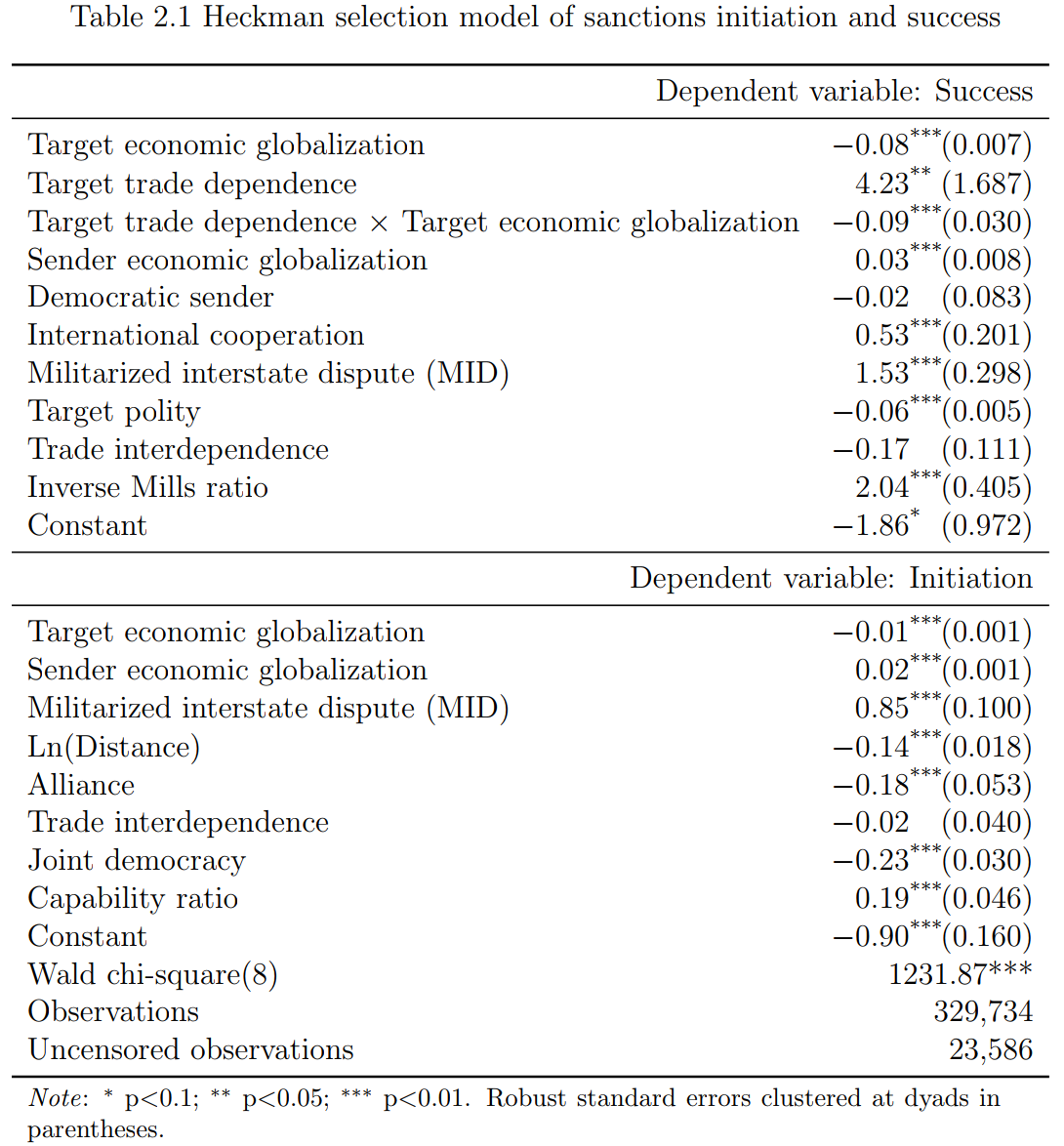
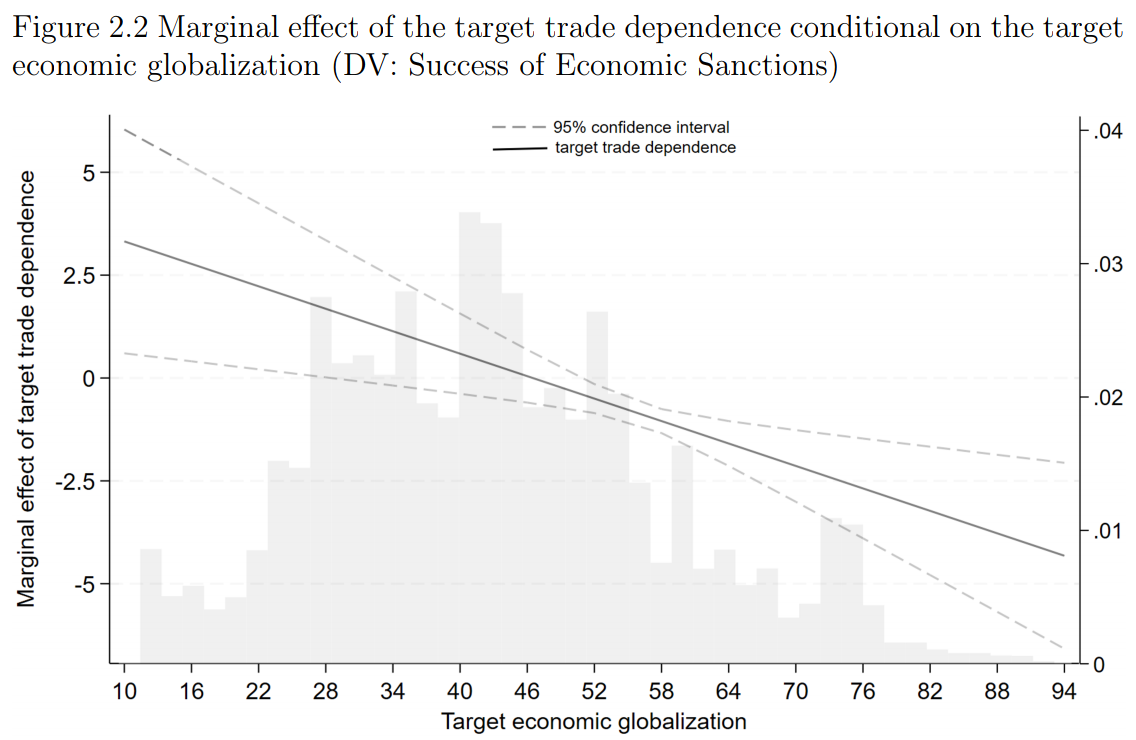
At the heart of this study lies a central paradox: as states become more economically and politically integrated, they gain leverage to punish others through coercive measures, yet they also incur greater exposure to external pressure themselves. Chapter 2 tackles this tension by dissecting economic globalization, distinguishing between de facto trade flows and de jure policy frameworks. Leveraging a Heckman selection model on cross–national data (1970–2021), I find that economically globalized senders are indeed more prone to initiate sanctions and more likely to achieve compliance, but their own market embeddedness grants them resilience against retaliatory measures. Moreover, targets exploit their network position to dilute sender leverage, transforming trade dependence into a strategic buffer.
Building on these insights, Chapter 3 turns to political globalization—the web of diplomatic alliances, multilateral institutions, and treaty obligations that bind states together. Here, I show that politically integrated senders harness institutional legitimacy and multilateral coordination to amplify sanction efficacy, while globalized targets—especially those with democratic governance—draw on third-party support and legal channels to undercut coercion. This analysis reveals that political globalization is not a unidimensional facilitator of coercion but rather a double-edged sword that reconfigures the strategic calculus of both senders and targets.
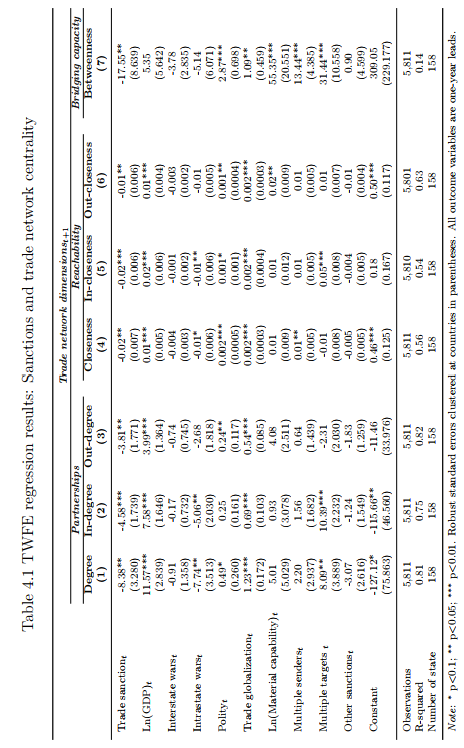
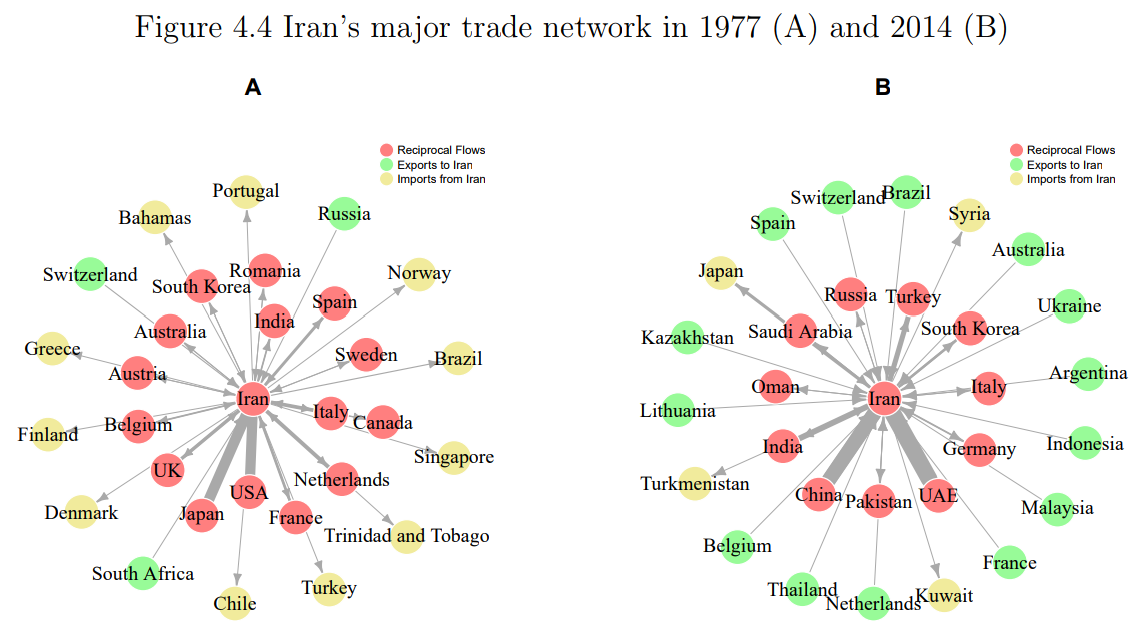
Finally, Chapter 4 casts a structural lens on sanctions by mapping their ripple effects through the global trade network. Drawing on network analysis of bilateral trade data (1950–2014), I demonstrate that sanctions inflict lasting damage on a target’s trade partnerships (degree centrality), market reachability (closeness centrality), and bridging capacity (betweenness centrality). A detailed case study of Iran illustrates how targets pursue regional realignment and informal trade channels to restore partnerships yet remain impaired in their intermediary roles.
Together, these chapters yield three principal contributions:
- Multidimensional theory of sanctions: By integrating economic, political, and network perspectives, the dissertation transcends dyadic models to explain when and why sanctions succeed or fail.
- Methodological innovation: The combination of Heckman selection models with network‐analytic measures offers a novel toolkit for capturing both causal leverage and systemic disruption.
- Policy guidance: The findings equip policymakers with a nuanced understanding of the strategic trade‐offs inherent in coercive diplomacy, highlighting how deeper globalization can both empower and constrain state action.
In the dissertation, I elaborate this framework in detail, test its implications with rigorous empirical methods, and discuss the broader implications for coercive diplomacy in an increasingly interconnected world.
Main Results
Because of space limitations, I present only the main regression results from each chapter here.
Chapter 2. Economic Globalization and the Use and Success of Sanctions
Chapter 3. Political Globalization and the Use and Success of Sanctions
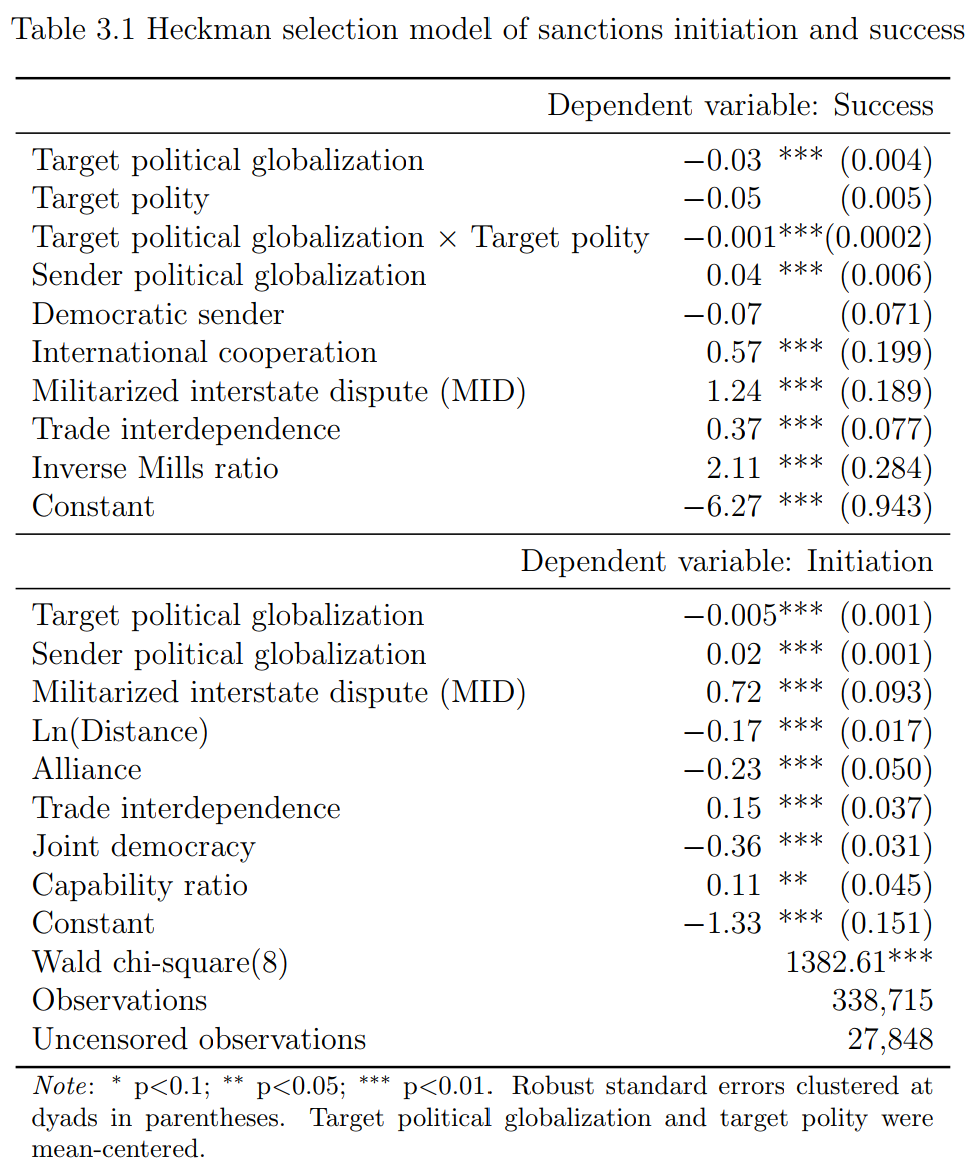
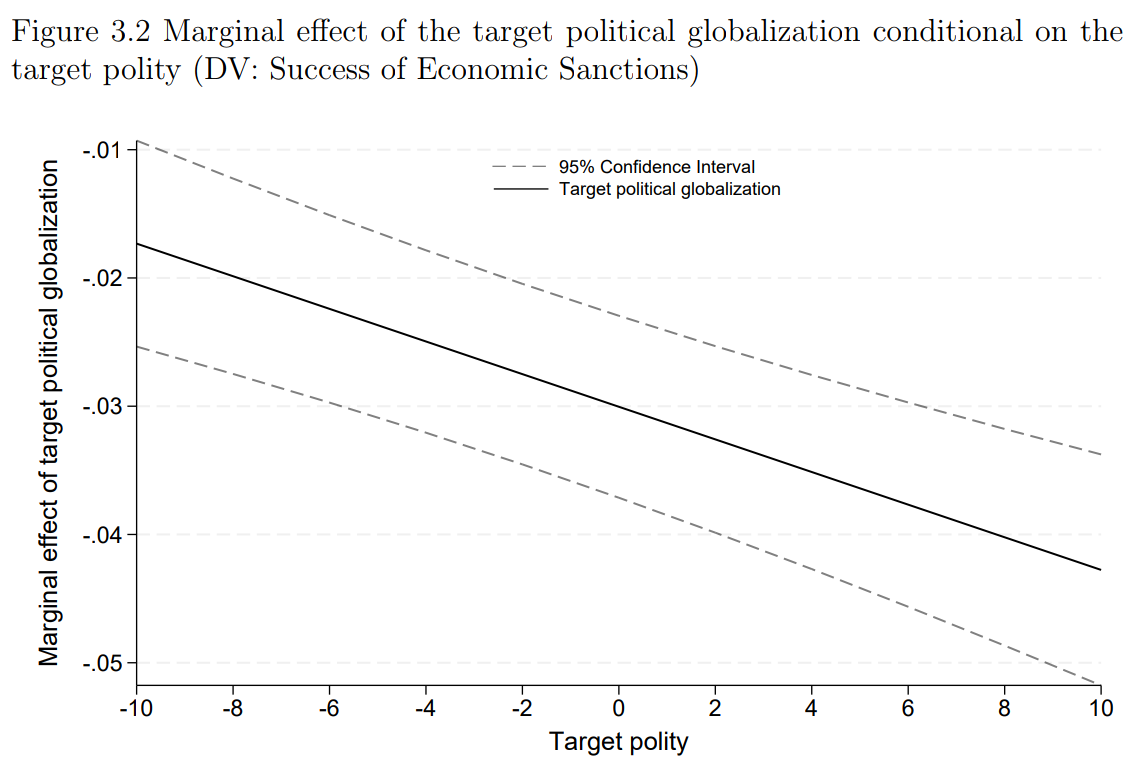
Chapter 4. Sanctions and Global Trade: A Network Analysis Approach
Conclusion
This dissertation has demonstrated that economic sanctions are far more than discrete policy instruments; they are dynamic interventions embedded within the complex web of globalization. By teasing apart the de facto and de jure dimensions of economic and political integration, the study reveals a central tension: globalization amplifies the coercive capacity of sender states while simultaneously endowing target states with the resources and institutional means to weather, adapt to, or even neutralize those coercive pressures. The evidence presented in Chapter 2 shows that deeply integrated economies not only initiate more sanctions and enjoy higher initial success rates, but also cultivate the very resilience that diminishes that success over time. Chapter 3 extends this insight to the political domain, illustrating how institutional memberships and diplomatic networks confer legitimacy on sender coalitions yet offer target regimes—particularly democratic ones—avenues for legal redress and third-party support.
Perhaps most striking is the structural perspective developed in Chapter 4, which casts sanctions as systemic shocks that reverberate through a target’s trade network long after formal measures expire. Reductions in partnership degree, market reachability, and bridging capacity do not simply recover in a linear fashion; instead, they give rise to path-dependent trajectories of regional realignment or informal trade channels. The Iran case study underscores this reality: despite a partial rebound in bilateral ties, the country’s intermediary role in broader value chains remains compromised, with implications for both regional stability and global market efficiency.
The policy implications of these findings are profound. Sanctions and broad-based tariffs alike must be conceived not merely in bilateral terms but as interventions that reconfigure global connectivity. The recent wave of U.S. tariff actions under Sections 232 and 301 provides a poignant example. Intended to pressure specific industries or trading partners, these measures have inadvertently cascaded through supply chains, raising costs for firms and consumers in allied states and prompting a scramble toward new suppliers and sourcing strategies. If coercive trade measures neglect the spatial logic of network externalities, they risk inflicting collateral damage on the very coalitions needed to sustain long-term diplomatic objectives.
Equally important is the recognition that targets are active agents in this process. The adaptive strategies observed—ranging from regional trade agreements to grey-market channels—reflect sophisticated responses that can blunt the intended impact of sanctions. Effective policy design, therefore, must combine coercive elements with calibrated engagement: sanctions might be paired with conditional incentives, dispute-resolution offers, or multilateral dialogues to forestall runaway fragmentation of trade networks. Moreover, strengthening the transparency and responsiveness of institutions such as the World Trade Organization could help balance the legitimate use of economic pressure with protections against abuse and overreach.
Looking to the future, several research trajectories emerge. First, scholars should pursue a multi‐level, sectoral analysis of sanctions’ impacts by combining macro‐level network metrics with firm‐ and industry‐level case studies. Rather than treating all trade links as homogeneous, this approach would disaggregate value chains into key sectors—energy, technology, agriculture, finance—and examine how sanctions propagate differently through each, how downstream firms adapt their sourcing strategies, and which segments exhibit the greatest resilience or vulnerability. Such fine‐grained analysis can reveal the micro‐mechanisms of disruption and adaptation that aggregate network models may obscure. Second, as digital platforms and cross-border financial systems assume ever-greater prominence, the framework must evolve to capture de facto and de jure dimensions of virtual interdependence. Analyses of cyber-enabled sanctions, financial exclusion from systems like SWIFT, or data-flow restrictions could reveal new forms of network disruption and target adaptation. Third, the ascendance of multipolarity—driven by the rise of China, the European Union’s strategic autonomy, and regional power realignments—calls for dynamic, time-sensitive models that can simulate how shifting alliances and rival blocs influence sanction diffusion and counter-measures.
In sum, this dissertation offers a holistic theory of sanctions as both reflections and drivers of globalization. It underscores that to navigate the intertwined imperatives of coercion and interdependence, scholars and policymakers must adopt a systemic lens—one that recognizes sanctions as interventions in a living network, not isolated policy levers. Only through such a perspective can we anticipate the full range of intended and unintended consequences, craft more effective strategies for coercive diplomacy, and ultimately contribute to a more stable and cooperative global order.